A colour takes two stylists. A bridal look needs a senior artist, a hair stylist and an assistant. The client pays once — but three people expect to be paid for their part. If the split is guessed at month-end, someone always feels cheated.
The good news: there is a simple rule that works in every salon, in any country and any currency. This guide walks through it step by step.
The short answer
- The client pays the salon once. Never ask the client to pay each stylist separately.
- Every service is its own line on the bill, credited to the stylist who did it.
- If two people did the same service together, split that line between them — equally, or by a share you agreed in advance.
- Take off any discount first, then work out commission on what the client actually paid.
- Tips go to staff, not to the salon — and they are split separately from commission.
Three ways stylists share one client
| Situation | Example | How to split |
|---|---|---|
| Different services, different stylists | Stylist A does the cut, Stylist B does the colour | Two lines on the bill — each stylist gets commission on their own line. No splitting needed. |
| One service done together | Two stylists do a long colour treatment side by side | Split that one line between them. Equal is simplest and the fairest default. |
| Main stylist plus assistant | Senior does the look, junior washes and preps | Agree a fixed share in writing (for example 70 / 30), or give the assistant their own smaller service line. |
Worked example 1: equal split
A colour service costs 200 (use your own currency — the maths is the same). Two stylists do it together. Both earn 20% commission.
| Step | Stylist A | Stylist B |
|---|---|---|
| Share of the service | 100 | 100 |
| Commission at 20% | 20 | 20 |
The client still pays 200. The salon still records 200 of sales. Only the commission is divided. Splitting the line — instead of giving the whole 200 to both — is what stops the salon paying commission twice on the same service.
Worked example 2: a discount on a shared bill
The client has two services: a cut for 100 by Stylist A and a colour for 300 by Stylist B. The bill is 400, and the client gets a 40 discount, so they pay 360.
The fair way is to spread the discount across the services by their price: the cut is a quarter of the bill, the colour three quarters.
| Cut (Stylist A) | Colour (Stylist B) | Total | |
|---|---|---|---|
| Menu price | 100 | 300 | 400 |
| Share of the discount | −10 | −30 | −40 |
| Actually paid | 90 | 270 | 360 |
| Commission at 20% | 18 | 54 | 72 |
If you paid commission on the menu price instead, you would pay 80 in commission on 360 of real money — the salon loses twice on every promotion.
Stop splitting bills by hand
TressyPOS splits the line, the discount and the commission for you
Tick the stylists on a service and every report and payslip updates on its own.
Start Free TrialWorked example 3: main stylist plus assistant
A bridal look costs 1,000. The senior artist and an assistant agreed a 70 / 30 share. The senior earns 25% commission, the assistant 10%.
| Senior artist | Assistant | |
|---|---|---|
| Share of the service | 700 | 300 |
| Commission rate | 25% | 10% |
| Commission | 175 | 30 |
Write shares like 70 / 30 into your commission policy on day one. Shares agreed “on the day” are the ones that turn into arguments.
How to split tips
Tips are the staff’s money, not the salon’s income. Keep them separate from commission:
- If the client names a stylist, the whole tip goes to that stylist.
- If the client leaves one tip “for everyone”, split it the same way you split the service.
- Record every tip on the bill and pay it out with the salary — cash handed over at the desk leaves no record and causes doubt later.
Our guide to salon tips accounting explains why tips should never sit in your sales figure.
Split payment is not the same as split staff
When a client pays part in cash and part by card, that is a split payment method. It decides where the money lands — the cash drawer or the bank — but it has nothing to do with which stylist earns what. Commission always follows the services, never the payment method.
Five mistakes that cause split arguments
- Giving the full service to every stylist who helped — the salon pays commission two or three times on one service.
- Commission on the menu price after a discount — you pay out money you never received.
- Agreeing shares verbally — put them in the written commission policy.
- Splitting at month-end from memory — one forgotten bill destroys trust. Split at the moment of billing.
- Mixing tips into sales — your revenue looks higher than it is and staff cannot see their tips.
Doing it automatically in TressyPOS
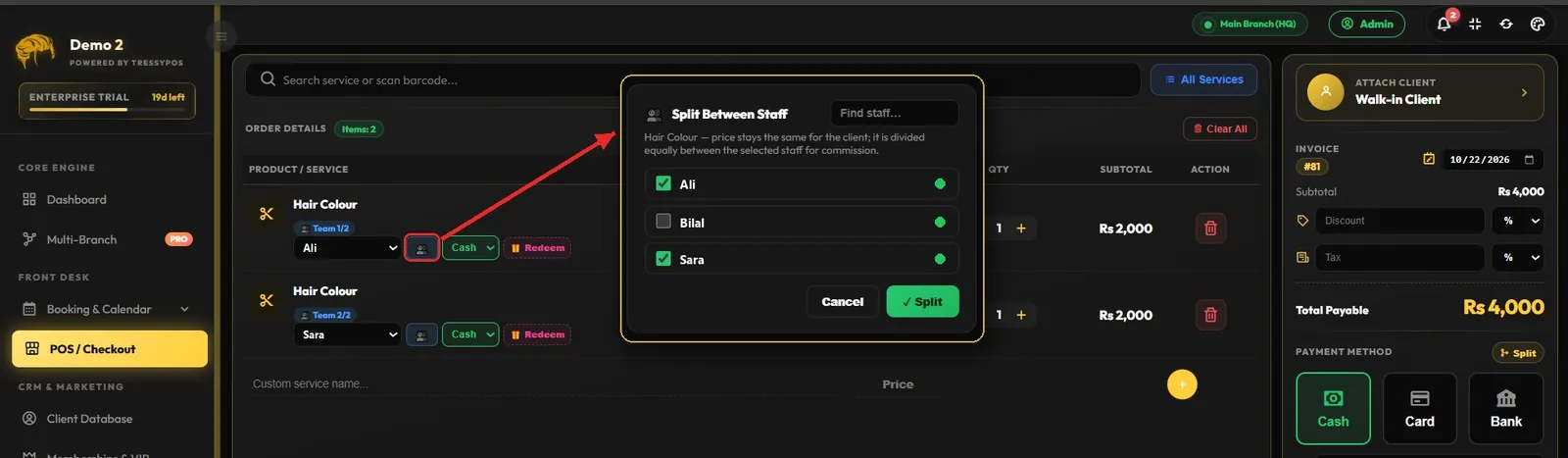
In TressyPOS billing every service line carries the stylist who performed it. Here is what splitting looks like at the till:
No credit card required · Cancel anytime
- Add the service to the bill as normal.
- Press the split button (👥) on that line and tick the stylists who worked on it. The line is divided equally between them and the client’s total stays exactly the same.
- Need 70 / 30 instead? After splitting, change the two line prices to 700 and 300. Each stylist keeps their own commission rate.
- Tips: every line has its own tip box, so each stylist’s tip is recorded against their name. For a team tip, type each person’s share on their line.
- Take payment once — cash, card, bank or a mix.
Bill discounts are spread across the services before commission is worked out, so stylists are paid on what the client actually paid. Tips stay out of your revenue. At month-end, payroll places commission and tips on each payslip automatically — no spreadsheet, no arguments.
TressyPOS is one flat subscription for the whole salon — no per-staff fee, so adding stylists never raises your bill. See pricing in your own currency. For the bigger picture, read our guide to salon commission structures.